Google Classroom Hack #6: Grade at a Glance with Colors

Illustration showing a Google Classroom grading strategy using color coding to organize assignments and streamline grading

Grading doesn’t have to feel overwhelming or time-consuming. With this simple Google Classroom grading strategy, you can organize assignments, monitor progress, and identify student needs at a glance. Using color coding in Google Classroom creates a visual system that helps secondary teachers streamline their workflow, stay organized, and respond more efficiently to student learning. If you’re looking for efficient grading strategies that save time without sacrificing meaningful feedback, this quick hack can transform the way you manage your digital classroom.

Google Classroom can take a while to load, so use this color-coding trick to make grading faster--without waiting for loading! If you color code your drag-and-drop or matching assignments, you can grade by simply looking at the thumbnail. Piece of cake!Last year at about this time, I started a spring survival series on my blog. And that seems to be necessary. The weather is warming, the student’s wardrobes are pushing the limits, and so are their attention spans.

And why not? Down here in balmy Georgia, we only have six more weeks until that glorious moment in time called summer break that comes and goes so quickly each year, but without which we surely could not survive.

When the weather is gorgeous, so few among us actually want to work. During the dreary winter months when the rain wouldn’t stop, I woke up at 5:30 each morning to drink coffee and get some work done. But now that it’s pretty outside and glorious summer is within reach, I hit snooze until 7:00 and roll out the door at 7:30, yelling at my son to, “Hurry up!”

If I am struggling–I know my students are.
Google Classroom can take a while to load, so use this color-coding trick to make grading faster--without waiting for loading! If you color code your drag-and-drop or matching assignments, you can grade by simply looking at the thumbnail. Piece of cake!
When I look up and see this, I struggle to focus.

The point is, I know it happens every year at about this time, so my goal is always to make it as painless as possible for my students and me without sacrificing the vital instruction time remaining. Last year at about this time, I wrote all about giving in and going outside and gallery walks for my spring survival tips. I even wrote about making grades the star (in order to remind students that they’re still accountable).

I still do all of these things; however, this year, I’ve made quite a change in my classroom. As my district is rolling out the 1:1 model (one Chromebook for every student), I’m blending my classroom (mixing technology with traditional instruction).

So, my spring survival tips this year will take the form of “Google Classroom Hacks.” And with that said, here goes number 6, a time-saving Google Classroom grading strategy (I’ll be counting down to 1):

Google Classroom Grading Strategy

If you are color blind, I apologize here and now, as this will not help you, just as any recipe containing flour will not help me (I have the autoimmune disorder Celiac–I can’t digest the protein gluten that is found in oh so many delicious things), and I know it’s frustrating.  
 
But for the rest of us, this is pretty cool.
 
As great as it is not to have to deal with stacks of paper and to have all assignments right in the same place, one of the nuisances of Google Classroom is having to open each of your students’ submitted assignments and wait for it to load. 

Well, if you have a simple one-page assignment that’s matching or drag-and-drop, wait no more! Color coding assignments in Google Classroom will save your sanity. Remember the color pattern of the correct responses, and open nothing. Just click on the assignment title from your desktop, and you will see small thumbnails of everyone’s submission lined up.

Glance at each thumbnail.  If all of the colors are lined up, it’s a 100. Mark down for incorrect answers from there. Best Google Classroom grading strategy ever.

Color Coding Assignments in Google Classroom
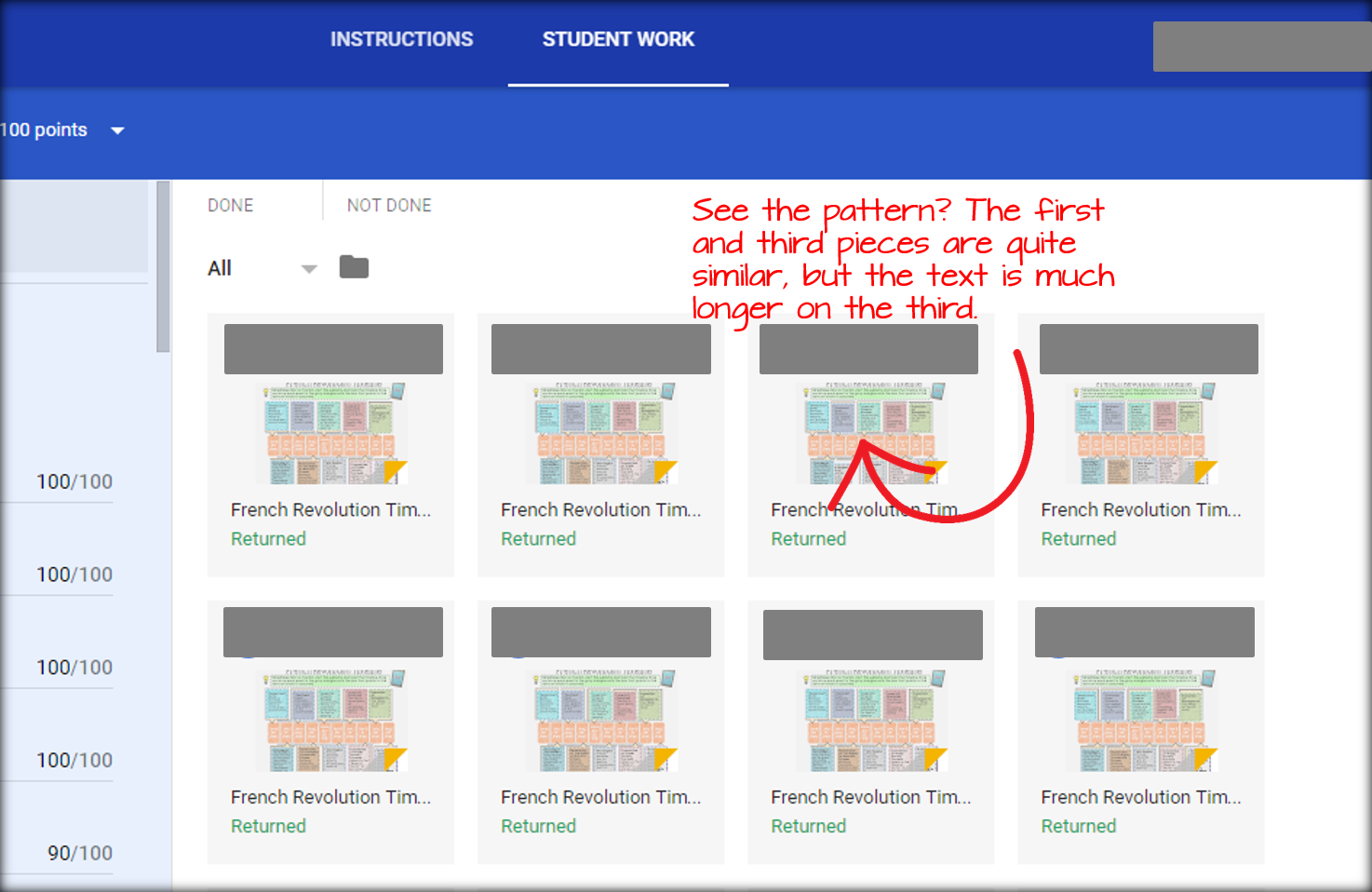
Using Google Classroom to visually compare student work and identify patterns quickly for faster grading and feedback
Scan student submissions in Google Classroom to spot patterns, differences in responses, and areas where students may need additional support—all at a glance.

I’m currently working on more color-coded drag and drop Google Drive activities, but I have a few on TPT now. And here’s a special just for this week. I have this French Revolution Timeline that is a one-pager and color-coded for “grading at a glance.” I will be adding interactive Google Drive notes to go with it, but until I add them, the timeline will be over half off–just $1.50.

French Revolution Interactive Timeline
Go on and snag it HERE

It’s a steal because if you get the timeline now, in a week you can download the notes, too at no additional charge.

What Google Classroom Hacks do you have? What Google Classroom problems would you like to see solved? Let me know in the comments below.
Read the next hack in this series–CLICK HERE.


    Email
    Facebook
    Pinterest
    Twitter

    You might also like...

    Colorful cut paper shapes including a pink circle, purple octagon, and green rectangle connected by yellow arrows on a teal background, representing graphic organizers for high school students and the digital graphic organizers vs paper debate for note catching strategies in the classroom.

    Graphic Organizers for High School Students: Should I Use Tech for This?

    You’ve heard of note-taking. Note-catching is something a little different. And that distinction is at the heart of this post. We’re looking at graphic organizers for high school students, and as part of the Should I Use Tech for This? summer series, we’re asking whether digital graphic organizers or paper serve high school students better, and the answer circles back to the same research that guided our note-taking post way back at the start of the series. We’re also covering the folded paper technique, standard annotation graphic organizers, and the one digital tool, NotebookLM, that does something for note-catching strategies that paper simply cannot replicate.

    Read More »
    A high school student giving a technology-enhanced presentation to classmates, illustrating creative student presentation ideas for high school and transformative technology use in the classroom.

    Student Presentation Ideas for High School: When Technology Genuinely Transforms the Work

    The best student presentations I’ve seen in my classroom came from a Theory of Knowledge class that turned their exhibitions into Saturday Night Live-style comedy sketches. They couldn’t have done it without technology. And they couldn’t have done it with AI alone either. In this post, part of the Should I Use Tech for This? summer series, I’m sharing what transformative student presentation ideas for high school look like, why creative student presentations go so far beyond the standard slideshow, and the one condition that makes technology work for this task rather than against it.

    Read More »
    Image of a magnifying glass over a dictionary for the post "Should I Use Tech for Vocabulary Practice Strategies?"

    Should I Use Tech for Vocabulary Practice Strategies? What I Learned the Hard Way

    I once built an elaborate digital vocabulary practice system, complete with drag-and-drop checkboxes and instructional videos, and I was so proud of it that I started selling it. It was a complete waste of everyone’s time. In this post, part of the Should I Use Tech for This? summer series, I’m sharing what that failure taught me about vocabulary practice strategies, why digital vocabulary tools for teachers shine at the surface level and fall flat at the deep and transfer levels, and how Quizlet, Quiz-Quiz-Trade, and a stack of laminated task cards all earned a permanent place in my vocabulary instruction for high school students.

    Read More »


    Welcome! Stay a while and browse classroom-tested tips, strategies, and resources that will take your teaching to the next level!

    Learn More

    Want Access To The Free Resource library?

    Get access to 20+ classroom-tested resources!