
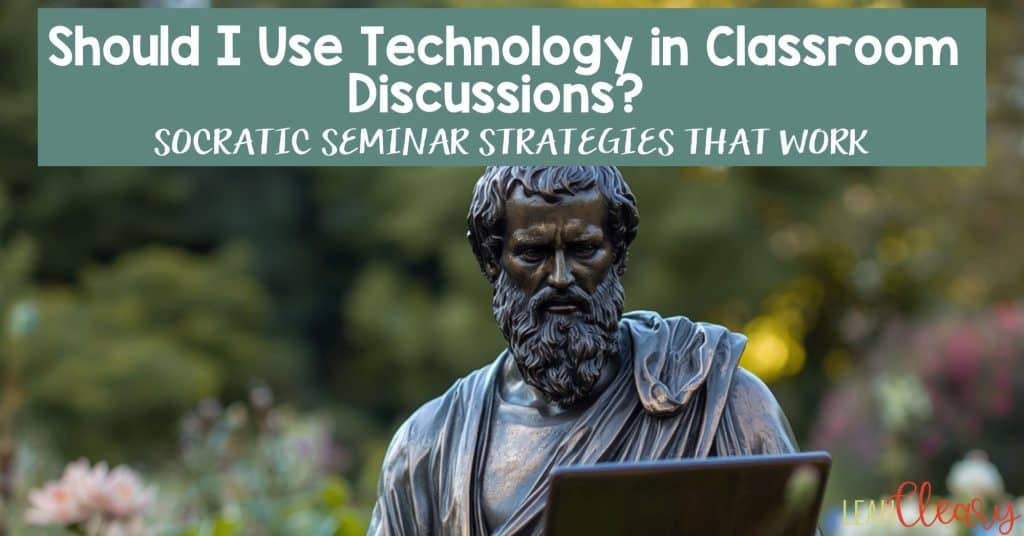
Ask most teachers whether they use technology in classroom discussions, and you’ll get a complicated answer. Socratic seminar strategies are built on face-to-face dialogue, active listening, and the kind of evidence-based reasoning that happens when students have to think on their feet. So where does a Chromebook fit into that picture? In this second post of the Should I Use Tech for This? summer series, we’re working through exactly that question — making the case for a fully analog seminar while showing how intentional technology use in the prep phase can produce discussion strategies for high school students that are sharper, better prepared, and more confident than anything a digital backchannel could deliver.
Table of Contents
Should I Use Tech for a Socratic Seminar?
If you read last week’s post on digital note-taking vs. handwriting, you already know where this series is going: we take one classroom task at a time, run it through a framework of five questions, and decide whether technology is appropriate for the task. Last week’s answer was pretty clear. Paper wins for note-taking (with specific exceptions).
This week is different.
The Socratic Seminar is one of my favorite strategies, and it’s also one of the most nuanced stops in this series. The seminar itself? Analog, full stop. But the for seminar preparation? That’s where technology can earn its place–if you use it with intention.
Let’s work through it.
What Is a Socratic Seminar, and Why Does It Matter?
If you’re newer to the strategy or want a deeper dive into how I structure and run Socratic Seminars in my classroom, I’ve written about it extensively over at Update Socratic Seminars with 5 Transformative Strategies.
The short version: a Socratic Seminar is a structured, student-led discussion built around a question or questions. Students sit in a circle, engage with each other’s ideas, back up their claims with evidence, and practice the kind of high-level thinking that doesn’t happen when a teacher’s doing most of the talking.
The seminar can be centered around an article, a novel, a short story, or a broad topic that students research.
I use an inner circle/outer circle format. The inner circle discusses while the outer circle observes and takes notes. Halfway through, they switch. At the end, students reflect on their own performance and set a goal for next time. My Socratic Seminar template (which walks through all of this, including the rubric and the reflection) is available in my Free Resource Library.
Don’t have the Free Resource Library Password? Sign up HERE.
This is one of those strategies that sounds simple but takes a lot of prep to do well. And that prep’s where the tech conversation gets interesting.
The Seminar Itself: Keep It Analog
Before we talk about where technology helps, let’s be clear about where it doesn’t.
The seminar itself should be device-free. Students in the circle, voices in the room, eyes on each other. That’s not a nostalgic preference. It’s the whole point. The value of a Socratic Seminar is the real-time, face-to-face exchange of ideas. Students have to listen actively, respond to what’s being said, and hold their thoughts long enough to build on someone else’s. That’s hard. It’s supposed to be hard. A device in their hands undermines undermines that process.
I’ve thought about using a digital backchannel during the seminar. A shared document where students can type reactions, track ideas, keep a record of the discussion. That sounds appealing on paper. But in practice, the device becomes a place for their attention to go when the discussion gets uncomfortable or slow.
And a Socratic Seminar that never gets uncomfortable or slow probably isn’t pushing students hard enough.
The better solution’s already built into the structure. Students in the outer circle have a job: they’re observing, taking written notes on the discussion, tracking who makes strong arguments, noting points that need elaboration, and identifying the best use of evidence. That’s meaningful, active work. And it’s done on paper. When they move to the inner circle, those notes become the fuel for their contributions.
After the seminar, students complete a written reflection on their own performance, score themselves using the rubric, and identify one specific way they’ll improve next time. Again, paper. The reflection needs to be theirs, and it needs to happen while the discussion’s still fresh. Not filtered through a screen.
Where Technology Helps: The Prep Sequence
Here’s where the answer to “should I use tech for this?” gets interesting. A well-prepared student has a better seminar experience (and let’s face it, we do, too when they’re not making things up as they go). And there’s a preparation sequence I’ve been using that layers technology in at specific, purposeful moments to sharpen students’ thinking before they sit down in that circle.
Fair warning: this sequence adds at least one full day to your prep timeline. It’s worth it, but go in knowing that if time’s an issue for you.
Here’s how it works.
Socratic Seminar Strategies
Step One: Start with a QuickWrite
Before any technology enters the picture, students write. I use my Inquiry-Based QuickWrite template for this — it’s also available in the Free Resource Library and connects directly to the inquiry-based learning framework I’ve written about HERE. Students respond in writing to the seminar’s driving question or questions. This is their unfiltered thinking before anyone else’s ideas influence them.
This step is analog, and that’s intentional. They’re processing on their own first. The tech comes next, and it builds on what they’ve already done.
Step Two: Add Short Answer for Peer Analysis
Once students have their QuickWrites, we move to Short Answer, a gamified writing tool that does something fabulous with student responses. Students type their QuickWrite into the platform, and then Short Answer puts two responses side by side on their screens. Students read both and select the stronger one based on specific rubric criteria. They do this repeatedly, working through their classmates’ responses in a tournament-style format. At the end, the top three responses win (and, yes, there’s candy involved in my classroom). We review those top responses as a class.
If you want to see a video of how this works, check it out HERE.
Why does this work? Because students are reading and evaluating each other’s thinking before the seminar begins. They’re seeing the range of ideas in the room, identifying what strong evidence-based reasoning looks like, and getting a sense of where the class stands on the main driving question (even though you’ll have at least eight questions in the seminar). That’s not busywork. That’s intellectual preparation.
Step Three: Research and Preparation
Now assign students all eight questions and have them research or read. I walk through how I structure this phase in detail in my inquiry-based learning post, so I’ll point you there rather than repeat it all here.
They can read or research in teams or individually, however you feel is best. They can identify their strongest evidence and begin building the arguments they’ll bring into the circle.
Step Four: Rehearse with MagicSchool Rooms
This is the tech piece that can transform how prepared students feel walking into the seminar. And that’s important because there’s nothing worse than having to sit through a seminar nobody’s prepared for.
MagicSchool AI has a feature called Rooms that creates a structured, AI-powered environment where students can practice their arguments before the live discussion. Here’s how to set it up:
- First, log into your MagicSchool account and navigate to the Magic Student section.
- Click to Create Room. From there, you can add tools specifically suited to seminar prep: the Socratic Seminar Generator, Text-Dependent Questioning, and Debate Analyzer are all worth exploring.
- You can attach your seminar rubric and any relevant texts directly from Google Drive. Then distribute the join code, URL, or QR code so students can access the room.
HERE’S a video that walks you through the process.
Once students are in, they can use the AI tools to generate high-level analytical questions from the texts, test their claims against textual evidence, and receive real-time feedback on the logic and depth of their preparation. Critically, the AI gives feedback without doing the thinking for them. It’s a rehearsal partner, not a ghostwriter.
After students have sharpened their arguments in the room, have them close their devices. The seminar begins.
A Note on Inclusion and the “Quiet Kid” Question
One reason teachers reach for digital backchannels during seminars is to give quieter students a way to participate without speaking up in a group. I understand that impulse completely. If a student’s genuinely terrified of participating, we want a solution. But I’d push back a little on that one.
A digital backchannel during the seminar doesn’t solve the participation problem. It just moves it to a different medium, plus it adds a distraction risk for everyone else. I think the better investment’s in the preparation sequence.
When a quieter student’s written their thoughts, analyzed their peers’ responses, committed to a position, conducted research, and rehearsed their argument with an AI tool, they walk into that circle with something to say. The preparation’s what builds confidence, not the availability of a chat window.
That said, total participation in a Socratic Seminar’s a goal, not a guarantee. If you want to dig into total participation strategies more broadly, I’ve written about that HERE.
So, Should I Use Technology in Classroom Discussions?
After all that…let’s run this task through the Should I Use Tech for This? framework. We start with the foundational question first, and only move to the others if the answer isn’t a clear no.
1. Can a student complete this task just as well (or better) without a device?
For the seminar itself: yes, better. Devices away.
For the preparation sequence: this is where technology can be transformative. Students can prepare for a Socratic Seminar without any of the tech I’ve described here. The QuickWrite, the peer analysis, the research or reading–all of that can happen without a device. But the tech enhances each step in ways that are hard to replicate without tech. Short Answer does something with peer writing analysis that passing papers around the room can’t replicate at scale. MagicSchool Rooms gives students an AI rehearsal partner that no analog alternative can match.
So the answer here is: maybe. Which means we keep going.
2. Does this task require students to process information, or just record it?
Processing, all the way. The entire prep sequence is designed to push students past surface-level familiarity with the content and into genuine argument-building. The tech tools support that processing rather than replacing it.
3. Does technology make this task possible, or just easier?
For Short Answer and MagicSchool Rooms specifically: it makes the task genuinely different, not just easier. Peer writing analysis at the scale Short Answer enables isn’t really possible without the platform. AI-powered argument rehearsal with real-time feedback isn’t possible without the tool. This is SAMR’s modification and redefinition territory. The technology is changing what the task can accomplish, not just digitizing a paper version of it.
4. Does using technology here create a distraction risk that outweighs the benefit?
During the prep sequence, the risk is manageable because students have a clear, structured task in front of them at every step. During the seminar itself, the risk absolutely outweighs any benefit, which is why they should put devices away for the discussion.
5. What do I want students to walk away with, and does tech help or hinder that outcome?
I want students to walk away having engaged in genuine, evidence-based dialogue with their peers, having listened, challenged, built on, and defended ideas in real time. Technology, used intentionally in the preparation phase, makes that outcome more likely. Technology during the seminar itself makes it less likely.
My answer for Socratic Seminars: It depends on when.
The seminar itself is analog. Non-negotiable. But the preparation sequence is one of the clearest examples in this series of technology doing something that paper can’t. And doing it to enrich a discussion that ultimately happens without any devices.
That’s intentional technology use. That’s the goal.
Next week, we’re moving on to Post 3 in the Should I Use Tech for This? series: Formative Assessment. That one goes both ways too, but for completely different reasons.


