Try Something New–Digital Task Cards

Digital task cards are great, but just like more traditional teaching methods, they can become stale and old when used too frequently. In this post I describe how I switch up my digital task cards to make them more interesting for students. Be sure to read the post and chime in with how you update your content mid-year to keep it fresh for students!I was talking to a group of my social studies friends not too long ago about how easy it is to fall into a rut–even with the fun stuff. Kahoot!, Jeopardy, Quizlet Live, Quizziz, Gallery Walks, Cutting and Folding, Stations–these are all fun, for us and the students, but once you’re halfway through the year and you’ve done all of this, it’s time for a change.

My school went 1:1 in August of 2016, and I’ve been blending my interactive notebooks (paper/digital hybrid) since January of 2016, so there’s a lot of variety in my classroom. Here’s a free guide about how to do it.

We color, we fold, we paste, we drag and we drop, we flip, we type, we use task cards as games and for we use them for review.

But assign the same thing over and over, and it becomes as stale as lecture and notes (which are great, used sparingly).

So I’ve decided to mix it up a bit with digital task cards. Have you ever noticed that changing the format and medium of something makes it more interesting?
Digital task cards are great, but just like more traditional teaching methods, they can become stale and old when used too frequently. In this post I describe how I switch up my digital task cards to make them more interesting for students. Be sure to read the post and chime in with how you update your content mid-year to keep it fresh for students!
Here it is!

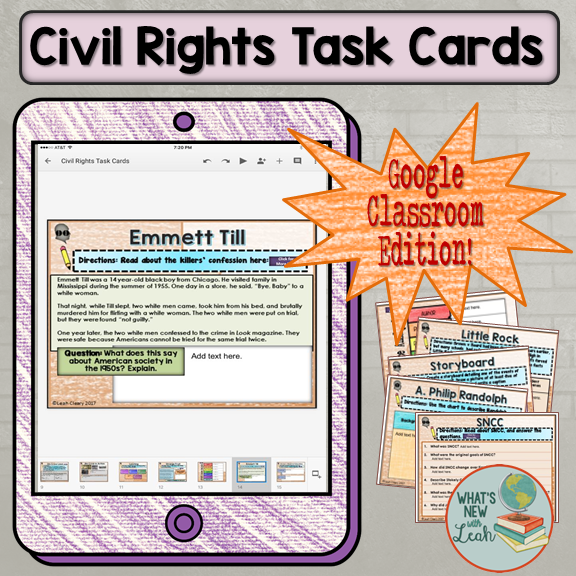
That’s what I’ve done with these digital Civil Rights Task Cards, and I’m very pleased with the results.

I assign these to my students in Google Classroom, so there’s no prep on my part. It’s basically a web quest, but don’t tell them that.

This format allows me to have them do comprehensive research over the American Civil Rights Movement in small bites, so they don’t realize they are doing comprehensive research.

The tasks on each card are more varied than simply asking and answering questions, so the students are engaged. Here are some examples:

Digital task cards are great, but just like more traditional teaching methods, they can become stale and old when used too frequently. In this post I describe how I switch up my digital task cards to make them more interesting for students. Be sure to read the post and chime in with how you update your content mid-year to keep it fresh for students!
Preview it here!

When they finish all 24 cards, there are four additional cards with mini-projects. I have them choose one to complete as an extension activity.

This way, when February and the Black History Program arrive, my students already have a good understanding of key events and the progression of the Civil Rights movement.

What strategies are you using to “freshen” up your content halfway through? Leave a comment below to let me know. And be sure to check out the links below to find out what new things other social studies teachers are doing this year in their classrooms!


    Email
    Facebook
    Pinterest
    Twitter

    You might also like...

    Colorful cut paper shapes including a pink circle, purple octagon, and green rectangle connected by yellow arrows on a teal background, representing graphic organizers for high school students and the digital graphic organizers vs paper debate for note catching strategies in the classroom.

    Graphic Organizers for High School Students: Should I Use Tech for This?

    You’ve heard of note-taking. Note-catching is something a little different. And that distinction is at the heart of this post. We’re looking at graphic organizers for high school students, and as part of the Should I Use Tech for This? summer series, we’re asking whether digital graphic organizers or paper serve high school students better, and the answer circles back to the same research that guided our note-taking post way back at the start of the series. We’re also covering the folded paper technique, standard annotation graphic organizers, and the one digital tool, NotebookLM, that does something for note-catching strategies that paper simply cannot replicate.

    Read More »
    A high school student giving a technology-enhanced presentation to classmates, illustrating creative student presentation ideas for high school and transformative technology use in the classroom.

    Student Presentation Ideas for High School: When Technology Genuinely Transforms the Work

    The best student presentations I’ve seen in my classroom came from a Theory of Knowledge class that turned their exhibitions into Saturday Night Live-style comedy sketches. They couldn’t have done it without technology. And they couldn’t have done it with AI alone either. In this post, part of the Should I Use Tech for This? summer series, I’m sharing what transformative student presentation ideas for high school look like, why creative student presentations go so far beyond the standard slideshow, and the one condition that makes technology work for this task rather than against it.

    Read More »
    Image of a magnifying glass over a dictionary for the post "Should I Use Tech for Vocabulary Practice Strategies?"

    Should I Use Tech for Vocabulary Practice Strategies? What I Learned the Hard Way

    I once built an elaborate digital vocabulary practice system, complete with drag-and-drop checkboxes and instructional videos, and I was so proud of it that I started selling it. It was a complete waste of everyone’s time. In this post, part of the Should I Use Tech for This? summer series, I’m sharing what that failure taught me about vocabulary practice strategies, why digital vocabulary tools for teachers shine at the surface level and fall flat at the deep and transfer levels, and how Quizlet, Quiz-Quiz-Trade, and a stack of laminated task cards all earned a permanent place in my vocabulary instruction for high school students.

    Read More »


    Welcome! Stay a while and browse classroom-tested tips, strategies, and resources that will take your teaching to the next level!

    Learn More

    Want Access To The Free Resource library?

    Get access to 20+ classroom-tested resources!