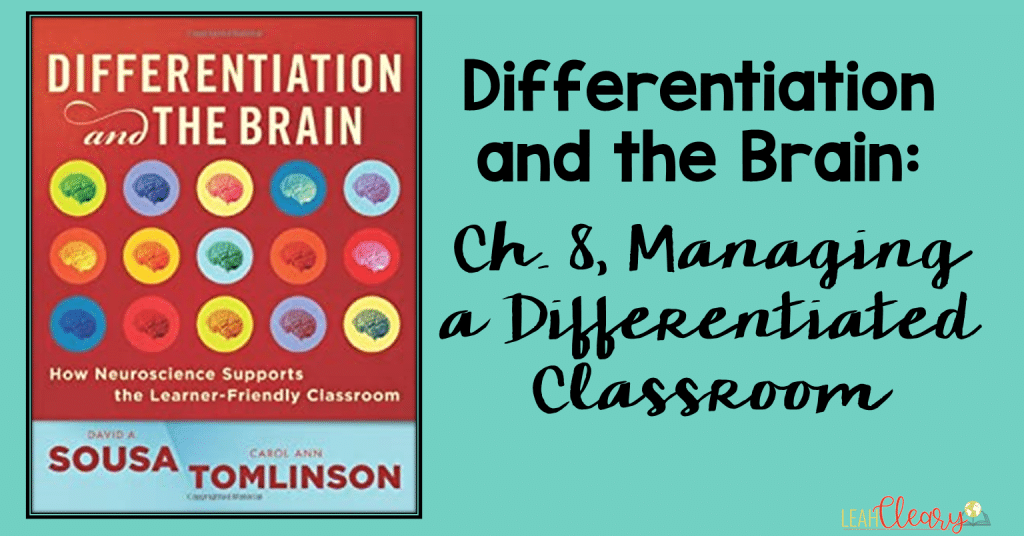
Differentiating and the Brain: Ch. 8 Managing a Differentiated Classroom

Cover of Differentiation and the Brain by Sousa and Tomlinson with title text about managing a differentiated classroom

Differentiation is often discussed as a strategy, but successfully managing a differentiated classroom requires understanding how students learn at the neurological level. Drawing on insights from Differentiation and the Brain, teachers can use brain-based learning principles to design instruction that responds to varied readiness levels, interests, and learning needs while maintaining structure and clarity. When educators align differentiation strategies with how the brain processes information, they can create classrooms that are both responsive and organized, allowing all students to engage meaningfully and make progress.

The Takeaway on Classroom Management in Differentiated Classrooms

Chapter 8 of Differentiation and the Brain delves into the difference between leadership and management and how leadership is what teachers should really be striving to achieve in their classroom routines. Additionally, the authors share some ways to use leadership to differentiate and meet students' needs. Click through to read the whole summary of this chapter.

This summer, the Tools for Teaching Teens group has been conducting a study of an incredibly useful book, Differentiating and the Brain by David A. Sousa and Carol Ann Tomlinson. I have learned so much from this book that I plan to implement in my classroom in the upcoming year. If you are just joining us, be sure to check out the other chapter summaries and reflections:

Introduction
Chapter 1: The Nonnegotiables of Effective Differentiation
Chapter 2: Mindset, Learning Environment, and Effective Differentiation
Chapter 3: Curriculum and Differentiation
Chapter 4: Classroom Assessment and Differentiation
Chapter 5: Differentiating in Response to Student Readiness
Chapter 6: Differentiating in Response to Student Interest
Chapter 7: Differentiating in Response to Student Learning Profile

This last chapter is full of ideas for managing a differentiated classroom. As I read, I found myself imagining the many ways I will transform my classroom this year.

Leadership is the Cornerstone of Managing a Differentiated Classroom

Chapter 8 distinguishes between leadership and management. Essentially, managers manipulate, while leaders build relationships. A differentiated classroom must be led through flexibility, not rigidity. Of course, management is a factor in leadership, but not the factor.

The first sign of a dysfunctional classroom is combativeness. There is a “me against them” attitude on the teacher’s part, and the students’ respond in kind.

This type of dysfunction doesn’t occur when the teacher is a genuine leader.

Tomlinson and Sousa offer strategies for becoming an effective leader. But before we delve into the strategies, let’s look at the principles at the foundation of leadership:

Chapter 8 of Differentiation and the Brain delves into the difference between leadership and management and how leadership is what teachers should really be striving to achieve in their classroom routines. Additionally, the authors share some ways to use leadership to differentiate and meet students' needs. Click through to read the whole summary of this chapter.
The key to becoming an effective leader is to build relationships with your students. Tomlinson and Sousa recommend doing this by
1. Learning their names right away
2. Sharing stories (yours and theirs) briefly every day
3. Acknowledging birthdays
4. Using humor (though not sarcasm).
 
Making the classroom belong to everyone is also imperative. Teachers should make students aware of class goals. Students should understand why the class is differentiated so that they will feel ownership in the classroom. They recommend a series of activities to illustrate the need for differentiation. One of my favorites is “Paper People.”
Chapter 8 of Differentiation and the Brain delves into the difference between leadership and management and how leadership is what teachers should really be striving to achieve in their classroom routines. Additionally, the authors share some ways to use leadership to differentiate and meet students' needs. Click through to read the whole summary of this chapter.
Chapter 8 of Differentiation and the Brain delves into the difference between leadership and management and how leadership is what teachers should really be striving to achieve in their classroom routines. Additionally, the authors share some ways to use leadership to differentiate and meet students' needs. Click through to read the whole summary of this chapter.Students color the person according to their preferences, and then display them to try to find one exactly like theirs–that doesn’t usually happen. You can download and print this handout by clicking HERE.

Differentiation Strategies for Secondary Teachers: Team-Building

Also, lead students in finding a shared classroom vision through team-building.
1. Students should understand why the classroom matters.
2. Students should understand why each person is important.
3. Students should feel pride in being a part of the classroom.
There are a ton of team-building ideas HERE.

While leadership is primary, management is secondary. Here are Tomlinson and Sousa’s ideas for managing a differentiated classroom:

Chapter 8 of Differentiation and the Brain delves into the difference between leadership and management and how leadership is what teachers should really be striving to achieve in their classroom routines. Additionally, the authors share some ways to use leadership to differentiate and meet students' needs. Click through to read the whole summary of this chapter.

The take away from chapter 8? Leadership is the key to managing a differentiated classroom effectively. Leadership emerges from building relationships. Care about your students. Care about their learning. Have a quality curriculum. All will be well.

What do you think? Do you have a differentiated classroom? Did you find this book as helpful as we did? Leave a comment below to let me know!


    Email
    Facebook
    Pinterest
    Twitter

    You might also like...

    Colorful cut paper shapes including a pink circle, purple octagon, and green rectangle connected by yellow arrows on a teal background, representing graphic organizers for high school students and the digital graphic organizers vs paper debate for note catching strategies in the classroom.

    Graphic Organizers for High School Students: Should I Use Tech for This?

    You’ve heard of note-taking. Note-catching is something a little different. And that distinction is at the heart of this post. We’re looking at graphic organizers for high school students, and as part of the Should I Use Tech for This? summer series, we’re asking whether digital graphic organizers or paper serve high school students better, and the answer circles back to the same research that guided our note-taking post way back at the start of the series. We’re also covering the folded paper technique, standard annotation graphic organizers, and the one digital tool, NotebookLM, that does something for note-catching strategies that paper simply cannot replicate.

    Read More »
    A high school student giving a technology-enhanced presentation to classmates, illustrating creative student presentation ideas for high school and transformative technology use in the classroom.

    Student Presentation Ideas for High School: When Technology Genuinely Transforms the Work

    The best student presentations I’ve seen in my classroom came from a Theory of Knowledge class that turned their exhibitions into Saturday Night Live-style comedy sketches. They couldn’t have done it without technology. And they couldn’t have done it with AI alone either. In this post, part of the Should I Use Tech for This? summer series, I’m sharing what transformative student presentation ideas for high school look like, why creative student presentations go so far beyond the standard slideshow, and the one condition that makes technology work for this task rather than against it.

    Read More »
    Image of a magnifying glass over a dictionary for the post "Should I Use Tech for Vocabulary Practice Strategies?"

    Should I Use Tech for Vocabulary Practice Strategies? What I Learned the Hard Way

    I once built an elaborate digital vocabulary practice system, complete with drag-and-drop checkboxes and instructional videos, and I was so proud of it that I started selling it. It was a complete waste of everyone’s time. In this post, part of the Should I Use Tech for This? summer series, I’m sharing what that failure taught me about vocabulary practice strategies, why digital vocabulary tools for teachers shine at the surface level and fall flat at the deep and transfer levels, and how Quizlet, Quiz-Quiz-Trade, and a stack of laminated task cards all earned a permanent place in my vocabulary instruction for high school students.

    Read More »


    Welcome! Stay a while and browse classroom-tested tips, strategies, and resources that will take your teaching to the next level!

    Learn More

    Want Access To The Free Resource library?

    Get access to 20+ classroom-tested resources!